
A holiday in the Greek islands often involves more travel planning than the distance on a map suggests. Mykonos, Santorini, Paros and Crete offer distinctly different experiences, but reaching them can require a combination of flights, ferries and road transfers. For travellers departing from London, Athens provides a useful starting point for organising these connections. Its international airport accommodates private aircraft and offers access to a broad network of onward transport services.
A private flight to the Greek capital can also be an opportunity to spend time in Athens before continuing to the islands. The city offers ancient monuments, established restaurants and accommodation ranging from small hotels to international properties. Travellers considering this itinerary can consult this flight guide for information about private charter services between London and Athens. The next decision is whether to continue by aircraft, take a commercial connection or travel by sea.
Athens is not a compulsory stop for every Greek island holiday. Several islands have airports capable of receiving suitable private jets directly from London, subject to aircraft performance and local operating restrictions. Others are better reached through the mainland or by ferry from neighbouring islands. Understanding these differences helps travellers choose a practical route without adding unnecessary transfers.
Flying from London to Athens
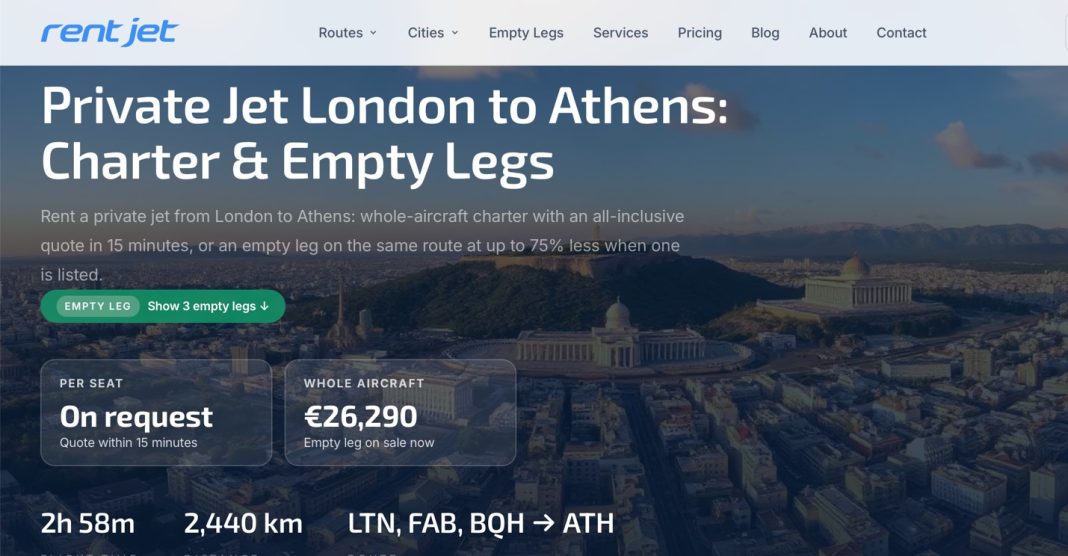
Private flights from London to Athens can be arranged through several business aviation airports, including Luton, Farnborough and Biggin Hill. The preferred departure point depends on passenger location, the aircraft available and the intended schedule. Travellers based in Surrey may find Farnborough convenient, while Luton can be a practical option for those coming from north London. Biggin Hill offers an alternative for passengers travelling from the south and southeast of the capital.
The distance between London and Athens is approximately 2,440 kilometres. RentJet indicates a flight duration of around three hours, although actual journey times depend on aircraft type, wind conditions and the airports used. Athens is therefore within the operating range of various private aircraft categories, but suitability must be confirmed for the particular passenger and luggage requirements.
For a couple travelling with limited baggage, a smaller jet may provide adequate capacity. Families or groups carrying equipment for a longer holiday may benefit from a midsize or larger aircraft. Selecting the appropriate jet involves balancing cabin space, baggage allowances, performance and cost rather than automatically choosing the largest available option.
Athens International Airport, also known as Eleftherios Venizelos, serves commercial airlines and business aviation. Specialist ground-handling companies provide services for private aircraft, including passenger arrangements and aircraft support. International travellers remain subject to the relevant passport, customs and security procedures, even when using dedicated business aviation facilities.
The airport lies east of central Athens, near Spata. Passengers planning to stay in the capital should account for the journey to their hotel, while those making an immediate onward connection need to coordinate arrival and departure arrangements. A separate flight may require additional handling procedures, especially when different operators are involved.
Travellers planning a multi-destination holiday should establish the entire itinerary before confirming the first aircraft. The most convenient London departure time may not correspond with a suitable onward flight or ferry connection. Coordinating these arrangements from the beginning can prevent several hours of unnecessary waiting after arrival in Greece.
Choosing the Right Island Destination
The Greek islands differ considerably in atmosphere, geography and the way visitors travel around them. Mykonos and Santorini are internationally recognised destinations, but they are not interchangeable. Crete is large enough to accommodate an extended holiday with several stops, while smaller Cycladic islands offer a different pace and may require additional transport arrangements.
Mykonos is known for its beach clubs, restaurants, nightlife and distinctive Cycladic architecture. The island attracts substantial international tourism during the summer, creating strong demand for accommodation and transport. Its airport can receive suitable private aircraft, but operating restrictions and limited parking make advance coordination important during the busiest months.
Santorini offers a landscape shaped by volcanic activity, with villages overlooking the caldera and accommodation concentrated around some of the island’s most famous viewpoints. Visitors often stay in Fira, Imerovigli or Oia, although these locations differ in atmosphere and accessibility. Santorini Airport handles both commercial and private flights, subject to operational requirements that become more restrictive when summer traffic increases.
Paros appeals to travellers interested in coastal villages, beaches and a more varied island itinerary. Naoussa and Parikia provide different bases for exploring the island, while smaller settlements offer quieter accommodation options. Paros has an airport, although the suitability of a private aircraft depends on runway characteristics, available services and operating conditions. Ferry connections from Athens and neighbouring islands provide alternatives.
Crete is a substantially larger destination. Its cities, beaches, mountain villages and archaeological sites are spread across a considerable area, making it better suited to longer stays than a hurried weekend. Heraklion and Chania provide major aviation gateways, and travellers should select their arrival airport according to their accommodation rather than assuming that all parts of the island are equally accessible.
The choice of destination should reflect how passengers intend to spend their time. A group seeking restaurants and nightlife may have different priorities from a family planning a week of swimming and sightseeing. For travellers with only a few days available, choosing one island generally makes more sense than attempting to visit several.
Continuing from Athens to the Islands
There are several ways to travel onward from Athens, and a private aircraft is not necessarily the most practical choice for every connection. Commercial airlines operate services to numerous Greek islands, while ferries connect the mainland with destinations throughout the Aegean. Private aviation can provide additional flexibility where airports and aircraft arrangements permit.
A private flight from Athens to Mykonos or Santorini can be relatively short, but the flying time represents only part of the journey. Aircraft handling, airport slots and transfer arrangements must be considered. During busy periods, an aircraft may be permitted to land and disembark passengers without being able to remain parked until the return journey.
This can create additional positioning flights. An aircraft delivering passengers to an island may need to depart for Athens or another airport where parking is available, then return when the passengers are ready to leave. These movements can affect charter costs and make an apparently simple island transfer more complicated than expected.
Commercial flights may offer a practical alternative, particularly when suitable schedules already exist. Passengers should compare departure times, baggage arrangements and the convenience of the arrival airport. A short scheduled service can be sufficient for travellers whose plans do not require a dedicated aircraft.
Ferries deserve consideration as well. Athens has several ports, including Piraeus and Rafina, with services operating to different island groups. Piraeus is a major gateway for the Cyclades and other destinations, while Rafina can be convenient for certain routes depending on the season. The most suitable port depends on the chosen island, sailing schedule and the traveller’s arrival time.
Sea travel introduces its own limitations. Ferry journeys can take several hours, and strong winds may cause cancellations or changes to schedules. Passengers arriving on an international flight should avoid booking a tight connection without allowing for possible delays and the transfer between the airport and port.
When organising onward travel, several questions help determine the most practical arrangement.
- Does the island have a suitable airport? Some destinations accommodate private jets, while others require smaller aircraft or connections by sea.
- Is a direct flight from London possible? An intermediate stop in Athens may be unnecessary if the destination airport can receive the selected aircraft.
- What are the seasonal restrictions? Summer airport slots, operating hours and parking limitations can influence the itinerary.
- How much luggage is involved? Aircraft capacity and ferry arrangements should accommodate all passengers and their belongings.
- Where is the accommodation located? The final transfer can differ considerably depending on the island and arrival point.
- How will the group return? Outbound and return arrangements should be planned together, especially when aircraft repositioning is required.
The best connection is not always the fastest flight. A suitable scheduled service or direct ferry may provide a more convenient overall journey than arranging a separate charter with additional airport procedures.
Summer Airport Restrictions and Weather
Greek island airports experience pronounced seasonal demand. During July and August, scheduled airlines, private aircraft and other aviation services compete for limited infrastructure at popular destinations. Mykonos and Santorini are particularly affected because their airports serve large numbers of visitors despite having comparatively limited space for aircraft parking.
Private aviation movements at these airports can require coordinated arrival and departure slots. Operators must also consider parking availability and the amount of time an aircraft is permitted to remain on the ground. At certain airports during the busy season, a jet may have to depart shortly after passengers disembark rather than wait for the return flight.
This matters when evaluating charter quotations. A passenger may expect to hire one aircraft for an entire holiday, but local restrictions can make that arrangement operationally impractical. The operator might need to reposition the aircraft elsewhere and arrange a separate return movement. The resulting expenses should be explained before the booking is confirmed.
Weather adds another variable. The Aegean is affected by the meltemi, a seasonal northerly wind that can become strong during summer. These conditions may influence smaller aircraft operations, ferry crossings and the comfort of journeys at sea. A warm, sunny day does not necessarily mean that aviation or maritime conditions will be straightforward.
The Greek islands also differ in their airport capabilities. Runway length, terrain, available navigation facilities and local operating hours can restrict the aircraft types that may use a particular destination. Travellers should not assume that a jet capable of reaching Athens can necessarily land at every island airport.
It is worth checking the operating arrangements before making non-refundable accommodation or transport commitments. A charter broker can assess aircraft suitability and coordinate the relevant permissions, but a requested flight remains dependent on the applicable airport and operational requirements.
For multi-island holidays, building flexibility into the schedule is particularly useful. An itinerary that depends on several tightly timed flights or ferry connections may become difficult to manage if one service is delayed. Leaving enough time between destinations allows passengers to enjoy the journey without placing the entire holiday at risk because of a single disruption.
Making Time for Athens
Travellers passing through Athens sometimes treat the city only as a connection point. Yet spending one or two nights in the capital can make the journey more rewarding, particularly for visitors who have not previously explored mainland Greece. The city combines significant archaeological sites with neighbourhoods, markets and restaurants that offer a different experience from the islands.
The Acropolis and its surrounding archaeological area are natural priorities for a first visit. The Acropolis Museum provides further context for the monuments, while nearby Plaka and Anafiotika offer streets that can be explored on foot. Visitors travelling during the hottest months may prefer to plan outdoor sightseeing for the morning or later afternoon.
Central Athens also has a varied restaurant scene, from neighbourhood tavernas to contemporary dining rooms. Areas such as Koukaki and Psyrri provide opportunities to explore beyond the most heavily visited streets. A short stay is enough to experience several parts of the city without attempting to cover every major attraction.
For passengers arriving on a private flight, the schedule can be arranged to include time in Athens before continuing to the islands. An afternoon arrival, overnight stay and onward journey the following day may be more comfortable than attempting to make an immediate connection. It also reduces the pressure created by delays on the first flight.
Athens can serve as a convenient final stop before returning to London. Travellers who have spent a week on an island may prefer to return to the mainland a day early, enjoy an evening in the capital and depart the following morning. This arrangement is particularly useful when onward transport from the island is vulnerable to weather disruption.
However, an Athens stop should have a clear purpose. If passengers want to spend their entire holiday on Mykonos or Crete and a suitable direct charter is available, adding the capital may increase travel time and expense without providing a meaningful benefit. The itinerary should be shaped around the destinations travellers actually wish to visit.
Planning the Complete Charter Itinerary
Private jet charter pricing depends on aircraft category, distance, availability and the operational requirements of the journey. A flight from London to Athens will have different costs from a charter continuing to one or more islands. Additional sectors, airport handling and aircraft positioning can make multi-destination arrangements more expensive than passengers initially expect.
The location of the aircraft before departure also matters. A suitable jet already positioned near London may produce a different quotation from an aircraft that must travel empty to collect the passengers. For a return journey, operators need to consider whether the aircraft remains in Greece, undertakes other assignments or returns from a different airport.
Travellers should therefore request a quotation for the complete itinerary rather than asking separately about each flight without explaining their wider plans. Passenger numbers, luggage requirements, island destinations and intended dates all influence which aircraft can be offered. A clear itinerary also helps identify where commercial flights or ferries may be more sensible.
Empty leg flights can occasionally reduce the cost of travelling privately. These occur when an aircraft needs to reposition between assignments and has available capacity. Discounts can be substantial, sometimes reaching 75% compared with a conventional charter, but the route and timing are determined by the operator’s existing commitments.
Such flights are best suited to flexible passengers. An empty leg from London to Athens may be attractive if the departure date fits the holiday, but it does not guarantee a convenient onward connection or return journey. Changes to the underlying aircraft schedule can also affect the flight, so booking terms should be examined carefully.
For families, coordinating the entire journey may be more important than securing the lowest price on one sector. Travelling with children, luggage and several connections requires realistic transfer times. Groups visiting more than one island should also consider whether the additional destinations justify the time spent moving between them.
Athens provides a valuable gateway to Greece because it combines international aviation infrastructure with extensive onward transport options. It can be the beginning of a holiday in the Cyclades, a convenient connection to Crete or a destination worth exploring in its own right. Its usefulness depends on the itinerary rather than on a requirement to pass through the capital.
A well-organised Greek island holiday leaves time for the places themselves. The aircraft, airport transfers and ferry connections should make those experiences easier to reach, not become the dominant part of the trip. Choosing a direct flight where practical, using Athens when it provides a genuine advantage and accounting for summer operating restrictions can make the journey considerably more manageable.


