
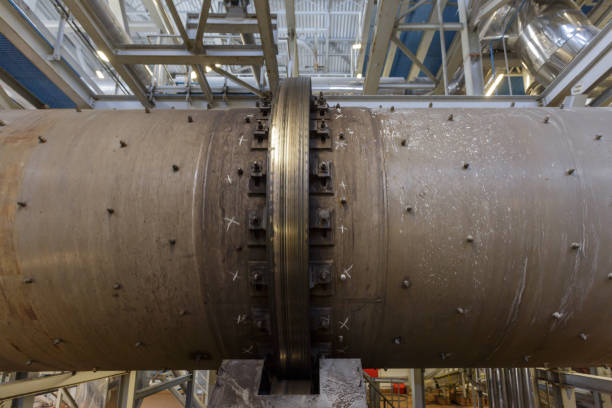
I remember the first time someone tried to explain to me how cement is actually made. I nodded along like I understood, but honestly I was lost after the second sentence. It wasn’t until I started writing about industrial equipment that I realized how genuinely complex the whole process is — and how much of it depends on one piece of equipment that most people outside the industry have never even heard of. The rotary kiln cement plant setup is basically the heart of the entire operation, and if that heart isn’t running right, nothing else really matters.
The Giant Spinning Oven That Makes Modern Construction Possible
So here’s the simplest way I can explain what a rotary kiln does. You know how when you bake something in your oven, the temperature and timing has to be just right? Too hot and you burn it, too cool and it doesn’t set properly. Now imagine that oven is a steel cylinder about 6 meters in diameter, anywhere from 50 to 90 meters long, slightly tilted, and it rotates continuously while materials slowly travel through it at temperatures exceeding 1400 degrees Celsius. That’s a rotary kiln. And in cement production, it’s the thing that transforms raw limestone and clay into clinker — the nodular material that gets ground down into the cement powder we use for literally everything.
There’s a stat that kind of blew my mind when I first came across it — cement is the second most consumed material on earth after water. Second. After water. And every single ton of it passes through a kiln like this at some point. So yeah, it’s kind of a big deal.
Why the Kiln Is So Hard to Get Right
Here’s where it gets interesting and also a little frustrating if you’re an engineer working in this space. The kiln isn’t just a heating device. It’s a chemical reactor. Inside, you’re driving off moisture, decomposing limestone into calcium oxide and CO2, and then triggering a series of exothermic reactions that form the calcium silicates and aluminates that give cement its binding properties. The whole sequence has to happen in a specific order, at specific temperatures, with a specific atmosphere inside the kiln.
And that last part — the atmosphere — is something I genuinely didn’t appreciate for a long time. I think most people assume it’s just hot air in there, but the oxygen levels, pressure differentials, and gas flow inside the kiln seals are carefully managed parameters. When they drift, product quality drifts with them. I’ve seen discussions on some of the cement industry LinkedIn groups where engineers share stories about clinker quality suddenly dropping and spending weeks diagnosing the cause, only to find it was false air infiltration through worn inlet seals. Weeks. For something that a proper sealing system would have flagged in hours.
The Seal Problem Is More Central Than You’d Think
This is the part where I might lose some people because seals sound boring. And honestly, fair enough. But stick with me for a second.
A rotary kiln has two main transition points — the inlet end and the outlet end — where the rotating drum meets the stationary hoods. At the inlet, raw meal enters the kiln. At the outlet, clinker exits into the cooler. Both of these transition zones are mechanically complicated because you’ve got a rotating surface interfacing with a fixed one, under extreme heat, with significant pressure differentials between the inside of the kiln and the surrounding atmosphere.
If the seals at these points aren’t doing their job, ambient air gets pulled in. Cold air. And cold air infiltrating a 1400 degree process doesn’t just cool things down a little — it disrupts combustion chemistry, increases fuel consumption, destabilizes the temperature profile, and makes emissions harder to control. There’s a rough industry estimate that in poorly sealed kilns, thermal energy losses from false air infiltration can eat up something like 8 to 12 percent of total energy input. In an industry where energy is the biggest operating cost, that’s not a small number.
What Actually Happens When Things Go Wrong
I talked to someone — not going to name anyone obviously — who worked at a cement plant in central India that was running with deteriorating kiln seals for longer than they should have. The plant kept adjusting fuel input to compensate for temperature inconsistencies, which masked the underlying problem for months. By the time they identified the real cause, they’d accumulated probably a crore or more in excess fuel costs and had a batch quality variance problem that was causing issues downstream with their concrete customers. The fix itself was far cheaper and faster than the months of patching around the actual issue.
This kind of thing happens more often than plants like to admit publicly.
The Bigger Picture
Cement manufacturing is under a lot of scrutiny right now — emissions targets, carbon intensity benchmarks, energy efficiency mandates. The industry accounts for something around 7 to 8 percent of global CO2 emissions, and regulators across Europe, India, and increasingly Southeast Asia are getting serious about pushing that number down. A lot of the conversation is about alternative fuels and carbon capture, which is valid. But some of the lowest-hanging fruit is just… running the existing equipment better. Tighter seals, better atmospheric monitoring, less false air, less fuel waste.
It’s not glamorous. Nobody’s writing excited press releases about improved kiln sealing systems. But the impact on efficiency and emissions is real and it’s measurable, and plants that have invested in proper sealing infrastructure consistently outperform those that haven’t on both energy and quality metrics.
Sometimes the unglamorous stuff is actually the most important stuff. That’s kind of the main thing I’ve taken away from spending way too much time reading about kiln operations.


